Why Fabric?
July 27, 2026 · 5 min read · Negin Nafissi
Turning data into information sounds simple, until you try it.
You start with scattered sources, different formats, unclear ownership, and inconsistent structures. Just pulling everything together can take weeks. And even when the data is finally available, modeling it for reporting, sharing it across teams, or predicting outcomes often means jumping between multiple tools, teams, and processes.
That complexity is exactly what makes many organizations slow to act on their data. It is not a lack of ambition or interest, it is just hard to get everything to work together.
Microsoft Fabric changes that.
The Problem: Too Many Tools, Not Enough Alignment
In most companies, data is everywhere but rarely unified. One team is working in Azure Data Factory, another in Power BI, someone else in notebooks, and the business is waiting for a report. The path from raw data to decision making gets fragmented, and with each step, time and context are lost.
Every team has their own tools, and often their own version of the truth. This makes collaboration difficult, slows delivery, and increases the risk of misunderstanding or duplicated effort.
The Fabric Vision: One Platform, One Flow
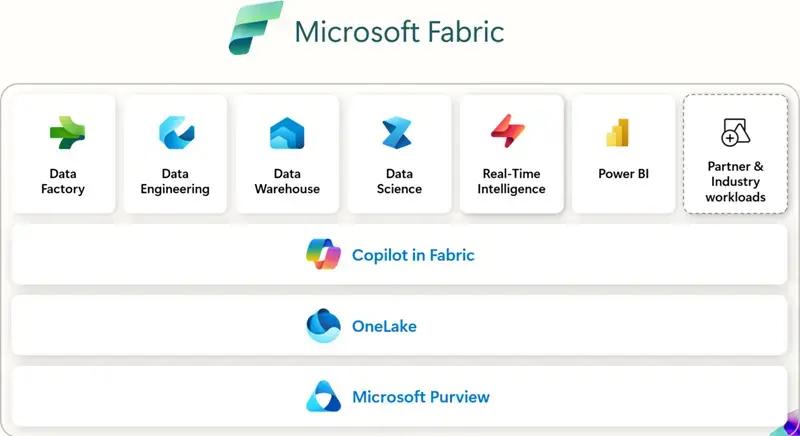
Microsoft Fabric brings everything together. It provides one place to handle the full data lifecycle, from data engineering and data science to reporting and real time insights. All the tools live in a single environment, with role-specific experiences depending on whether you are an engineer, analyst, or decision maker.
Fabric is not just another data platform. It is a rethinking of how teams can work together. Instead of passing data between systems and roles, Fabric invites everyone to collaborate in a shared space, with shared tools, and shared purpose.
OneLake: A Common Ground for Everyone
At the center of Fabric is OneLake, a unified data lake that acts like OneDrive for your data. It removes the need for complex data copying or syncing between tools. Everything connects directly to OneLake, whether you are building pipelines, querying in SQL, or creating dashboards.
It supports open formats and integrates with existing Azure Data Lake structures, which means teams can work with what they already have. Most importantly, everyone works with the same data, which makes collaboration cleaner and more reliable.
How Fabric Simplifies the Data Lifecycle
Fabric makes the data journey more accessible:
- Ingest data using pipelines, connectors, or real time sources
- Transform and clean it using Spark notebooks or dataflows
- Build semantic models for reuse across reports
- Create visual insights directly in Power BI
- Share results in workspaces where everyone sees the same thing
This smooth flow reduces context switching, eliminates handover delays, and makes it easier to maintain consistent logic from ingestion to insight.
Why It Matters: Time, Trust, and Teamwork
Fabric reduces the time it takes to go from raw data to decisions. It helps teams trust their data by eliminating duplication and version mismatches. And it improves teamwork by giving everyone a shared language and space to work in.
Software engineers will see familiar patterns, with cleaner architecture and modular building blocks. Data engineers will appreciate the centralization and flexibility. Business users will love how quickly insights are delivered and how easily they can explore data on their own.
From Theory to Action
Fabric is not just a technical solution. It is a shift in mindset. Instead of building isolated pipelines and hoping they align later, teams can now build together from the start.
This platform helps software engineers transition into the data space by lowering the barriers and increasing reuse. It helps data engineers build more meaningful systems by removing repetitive handoffs. And it helps businesses finally activate their data with less complexity.
Data Without Complexity
That is why Fabric matters. It turns a scattered and slow process into one that is unified, connected, and easy to navigate. It makes data feel accessible, usable, and impactful.
In the next article, we will take a closer look at collaboration and one of the most exciting shifts in data thinking: the rise of the data mesh.